I keep telling myself it’s “not that bad” at work… but my body is falling apart.
Dear RUBY,
Nothing huge has happened at work, which is almost the problem.
I’m not dealing with one big incident I can point to. It’s more like a constant drip: the tone-policing, the subtle put-downs, the meetings where I disappear, the “feedback” that feels like a warning even when it’s wrapped in a smile.
I keep telling myself it’s fine. I keep functioning. I keep producing. I’m actually quite proud of the work I’m doing…
And yet my body is paying for it. My jaw is wrecked. My sleep is shallow. My shoulders live up by my ears. I get headaches, stomach stuff, and this weird blankness in meetings where I can’t find words, and then I replay everything later at night at 1:30am like a crime scene.
Part of me thinks I’m being dramatic, and part of me knows I’m not.
Is this actually trauma? Or am I just not cut out for this?
— Polished on the outside, braced on the inside
Dear Polished,
The conference room is cold, your laptop is open, and you can already feel your breath getting shorter. Your smile turns on before you decide to smile, and your body starts organizing itself around one job: don’t make this worse.
Denial at work is rarely loud. It’s smooth.
I’m trained in a modality called Somatic Experiencing created by Peter Levine. He teaches that denial can be a lower-energy form of dissociation which is less like disappearing completely, more like turning the volume down on what happened, what you felt, and what it meant.
Workplaces that punish truth-telling, especially for women, often train this volume-down response as a survival skill.
Denial at work almost never sounds like: “That didn’t happen.”
Instead we say things to ourselves on the drive home like:
“It wasn’t that bad; I’m overreacting.”
“He’s under a lot of pressure.”
“That comment was probably meant as a joke.”
“If I just do better work, it’ll stop.”
“It’s just the culture. I should adapt. It’s like this everywhere.”
Read that again and notice what it does in your body.
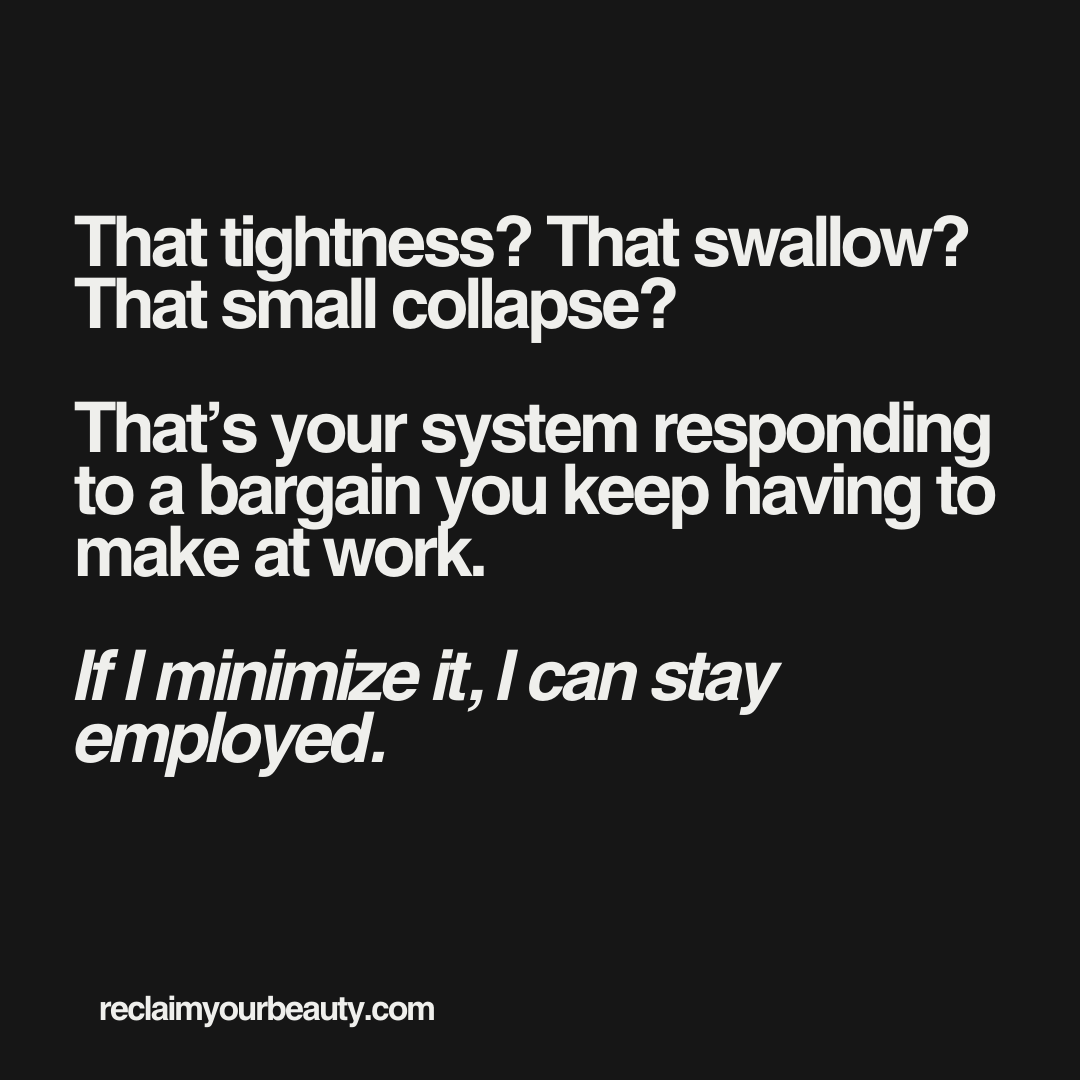
That tightness? That swallow? That small collapse? That’s your system responding to a bargain you keep having to make:
If I minimize it, I can stay employed. If I keep it small, I can keep moving.
And because women are often expected to manage everyone’s comfort, denial gets rewarded as “professionalism.” But the truth is, these are what we call trauma responses and what I’ve named somatic survival loops.
And here’s the cruel twist…
The loop works amazing well, until it doesn’t. It helps you get through the meeting, keep your paycheck, stay “liked,” and avoid the hit of being labeled difficult.
But your body always collects the debt later, in headaches, braced shoulders, shallow sleep, jaw pain, gut flare-ups, and that blank-out feeling when you most need your words.
A somatic survival loop isn’t a weakness or a mindset issue, it’s an intelligent pattern formed under constraint, and it can be renegotiated once you stop calling it “fine” and start listening to what your sensations have been trying to say.
Dissociation at work looks like “being fine”
Levine describes dissociation as disconnection between mind and body, feelings and thought, sensations and action. In the workplace it can show up like this:
You hear yourself speaking, but it feels like you’re watching it happen.
You can’t find words in the moment, then you write a perfect paragraph at 11:47 p.m.
You smile while your stomach drops.
You forget the details of the meeting, but your body remembers all evening.
A dominance-heavy environment practically trains you to stay pleasant, stay functional, stay disconnected enough to keep producing.
So no, this doesn’t mean you’re “not cut out” for work. It means your system is trying to keep you safe in an environment where belonging and paychecks are conditional on playing a role and self-extracting.

Why your body does this (and why it’s not your fault)
If naming harm could cost you status, income, safety, future references and belonging? Your nervous system goes into safety mode and dampens:
grief
rage
clarity
the impulse to push away
the impulse to leave
That dampening is your brilliant body biology negotiating captivity-by-economics.
The cost: your symptoms become the messenger
When the mind keeps saying “it’s fine,” the body starts sending messages that are harder to ignore.
Jaw pain. Headaches. Insomnia. Gut issues. Shoulder armor. Pelvic bracing. Numbness. A racing heart before meetings. The “blank mind” when you’re put on the spot.
Your system is saying:
“You keep calling it fine. I’m calling it threat.”
This is why I don’t treat symptoms as inconveniences. I treat them as signal.
The Good Girl bind
Here’s the bind many women are trapped in:
Denial keeps you easy to work with.
Dissociation keeps you high performing.
Both keep you employed.
Neither lets the survival cycle finish.
So your work isn’t to become tougher. Your work is to restore choice in tiny, survivable doses.
Micro-completions (that won’t blow up your life)
You asked, “What do I do?” Here’s the start.
1) Name it, privately
Not a confrontation. A sentence inside your own skin:
“My system is minimizing.”
“I’m disconnecting to get through this.”
Naming reconnects the split.
2) Track one sensation for 10–20 seconds
Choose one: throat, chest, belly, jaw, hands, feet.
Find: edge, temperature, pressure.
Then let your eyes land on something neutral in the room.
You’re reminding your body: this is now, not then.
3) Pendulate (resource ↔ activation)
10 seconds: feel your feet or back supported by the chair.
10 seconds: touch the sensation.
Repeat three rounds.
This lets your system feel truth without flooding.
4) Allow 2% completion
At work, completion is often subtle:
press feet into the floor
lengthen your spine
exhale longer than you inhale
unclench jaw and swallow
stop overexplaining mid-sentence
take one clean pause before answering
Small moves teach a big lesson: I can stay with myself.
5) Discharge later, on purpose
After work: shake out arms, push the wall, slow walk, hum. Give your body an ending that the meeting couldn’t.
A list to keep you honest (Denial phrases)
When you catch yourself saying any of these, treat it like a signal not a personal failure:
“It wasn’t that bad.”
“I’m probably overreacting.”
“They mean well.”
“That’s just the culture.”
“I can’t prove it.”
“If I keep my head down, it’ll pass.”
“It’s just stress.”
Try this once:
Say the denial sentence. Then say the truer sentence underneath it.
“It wasn’t that bad.” → “My body felt threatened.”
“They’re under pressure.” → “Pressure doesn’t entitle mistreatment.”
“I can’t prove it.” → “I don’t need a courtroom to trust my nervous system.”
Your boundary, starting today
Here’s the line I want you to practice until it feels as solid as bone:
I don’t minimize what my body knows.
You may not be ready to leave. You may be playing a long game. That’s real.
But you can stop gaslighting yourself while you do it.
And I’ll add one more boundary from me to you:
I won’t help you become more tolerable to a system that profits from your self-extraction.
With you,
Ruby
Gentle note: If symptoms are new, severe, or escalating, medical support matters alongside somatic work. Your body deserves thorough care.